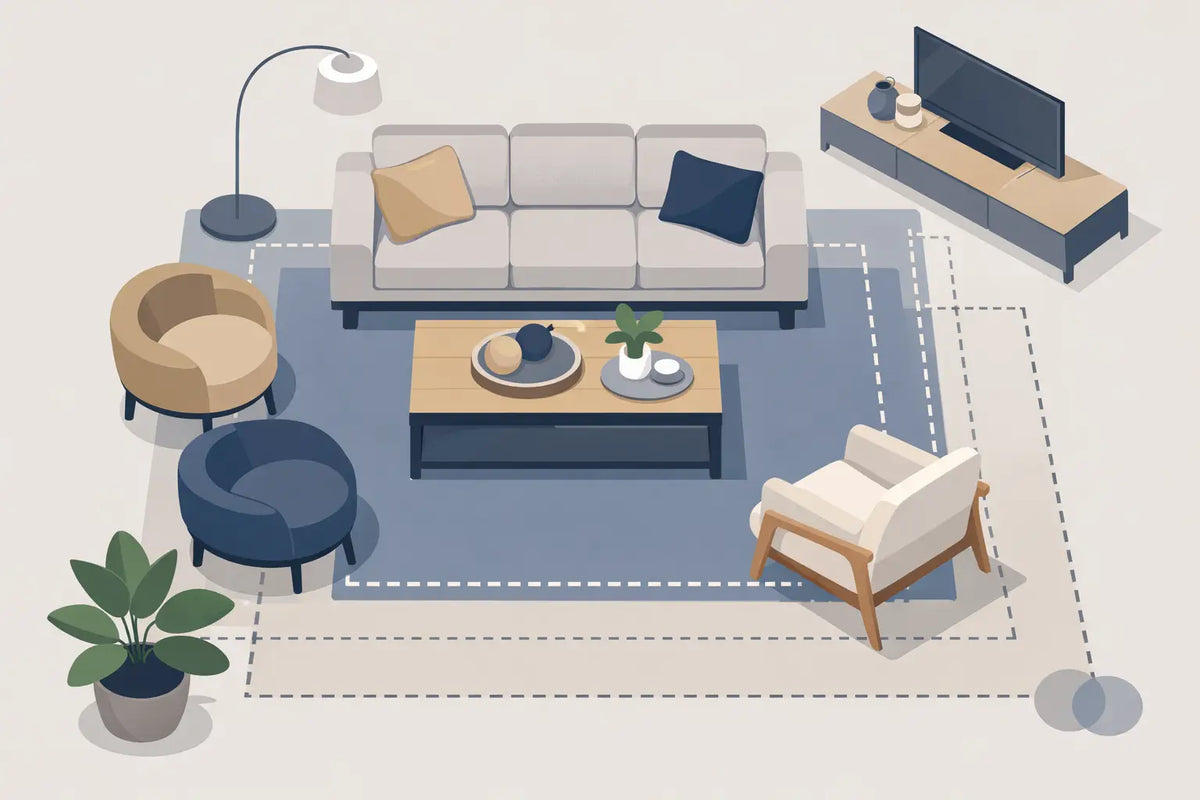
A seating area can be beautifully decorated, but with a rug that is too small or just too large, the entire space quickly feels unbalanced. The right rug size for your seating area makes the difference between a living room that just happens to be together and a place that truly feels warm, calm, and finished. That’s exactly why it’s worth looking not only at color or pattern but first at the size.
Why the size of your rug matters so much
A rug does more than dress up your floor. It connects the sofa, coffee table, and chairs into one whole and literally brings softness to the space. Especially in Belgian living rooms, where tile floors, parquet, or laminate often form the base, a well-chosen rug provides extra comfort and a quieter, cozier atmosphere.
Yet this often goes wrong. Many people choose a size by sight and pick a smaller model because it feels safe or seems more affordable. But a rug that’s too small makes your seating area look fragmented. The furniture seems disconnected, making even a beautiful setup appear less harmonious.
A larger rug usually looks calmer and more luxurious. It gives your living room more cohesion and lets the furniture stand out better. That doesn’t mean bigger is always better, but the proportions need to be right.
Right rug size for seating area – the 3 most common arrangements
The best size depends on how your furniture is arranged. Not every seating area requires the same approach. It helps to first look at the position of the front legs of your sofa and chairs.
All front legs on the rug
This is the safest and most attractive choice for many living rooms. You place the rug so that the front legs of the sofa and any armchairs rest on it, while the back legs remain on the floor. This way, the seating area feels connected without the rug having to fill the entire room.
For an average living room, this often works well with sizes like 160x230 cm or 200x290 cm. Which of the two fits better depends on the width of your sofa, the distance to your coffee table, and how much free floor space you want to keep around it.
All furniture fully on the rug
If you have a spacious living room, the rug can be chosen generously. When the sofa, chairs, and coffee table all sit fully on the rug, you get a distinct hotel feel – comfortable, elegant, and very polished.
This works especially well in open living spaces where you want to visually define the seating area. The space must be large enough, though. In a smaller living room, this solution can quickly feel heavy if the rug is too close to the walls or other furniture.
Only the coffee table on the rug
This is the arrangement that often disappoints. A small rug under just the coffee table may look charming in photos, but in practice, the seating area often lacks warmth and unity. The rug then seems more like a loose accessory than a full part of your interior.
Still, it can work in a compact studio, a small reading nook, or when you deliberately want a light, minimalist look. In that case, it’s best to choose enough width so the rug doesn’t look lost among the furniture.
How to determine the right size in your living room?
Don’t start with the rug, but with the outer dimensions of your seating area. Measure the width of your sofa, add the distance to the chairs or side tables, and see how much of that zone you want to visually connect. This way, you avoid choosing a rug that is beautiful on its own but not in proportion to the space.
A handy rule of thumb is to let the rug extend at least 15 to 25 cm wider on both sides than the sofa. This gives the whole arrangement breathing room. If your rug is exactly as wide as your sofa, it often looks just too narrow.
Also consider the coffee table. There should be enough rug visible around the table; otherwise, the effect disappears. A rug should support your seating area, not disappear beneath it.
If you’re unsure, you can first tape the size on the floor with painter’s tape. This is an easy way to see the effect in the room before you order. You’ll immediately notice whether the chosen size enhances the space or feels too tight.
Popular sizes and when they fit
A rug of 120x170 cm is usually too small for a full seating area. It can still work for a compact two-seater or in a small apartment, but for a classic living room, this size rarely provides enough visual calm.
160x230 cm is a popular size for smaller seating areas. Think of a two-seater with one armchair or a compact setup in an apartment. Here, it’s important that at least the front legs of some of the furniture rest on the rug.
200x290 cm is the golden middle ground for many families. This size offers enough presence without being overwhelming. For a standard three-seater and coffee table, this size often provides the best balance.
240x340 cm comes into its own in larger living spaces. If you have a corner sofa or a generous U-shaped setup, this size gives the seating area a rich and calm character. The difference with a too-small rug is immediately visible here.
Don’t forget the shape
Not only the dimensions but also the shape matters. A rectangular rug is the classic choice and fits most living rooms. It usually follows the line of a sofa or corner sofa nicely and brings structure to the space.
A round rug can add softness, especially if you have many straight lines in your interior. Under a compact seating area or combined with a round coffee table, it creates a more playful effect. In a larger, sleek setup, a round model is sometimes less practical because it connects less surface area.
For an organic or asymmetrical seating area, it depends on what you want to emphasize: calm and definition, or movement and softness.
What if you have a corner sofa?
With a corner sofa, the right rug size for the seating area is especially important because such furniture takes up a lot of space. A rug that’s too small makes the setup look clumsy and unbalanced. Often, it’s best to choose a size where both the long and short parts of the sofa partly rest on the rug.
In practice, you’ll quickly end up with 200x290 cm or larger. Especially if there’s also a coffee table and extra armchair, the rug should be large enough to support the entire seating area. A small model in the middle only highlights what’s missing.
If you have a compact corner sofa in an apartment, a smaller size can work, but only if the proportions are right. So it depends on the room, not just the furniture.
Material and usage also make a difference
Choosing the right size is one thing, but also consider how intensively the seating area is used. In a family with children or pets, you want not only a beautiful rug but also a practical solution. Then maintenance-friendly materials, a low-pile structure, or a washable model are especially interesting.
A softer, plusher rug provides a lot of comfort underfoot and makes the seating area extra inviting. On the other hand, a high-pile rug requires more maintenance and is less practical if chairs or tables are often moved. Low-pile rugs look cleaner and are easier to use, especially in busy living spaces.
Anti-slip is also no small detail. A rug that stays in place not only feels safer but also creates more calm in daily use. This is a big advantage, especially on smooth floors.
The most common mistake: choosing too cautiously
The biggest mistake is rarely that a rug is a bit too large. Usually, it’s the opposite. People choose cautiously, want to keep the budget under control, or fear the rug will be too dominant. But once it’s in the living room, it often turns out to be too small to really create atmosphere.
Smart buyers therefore look at the total value. A rug that visually enhances the space makes your furniture stand out better and increases comfort every day. Then a well-chosen size doesn’t feel like an extra cost but an investment in your interior.
At Omid Carpets, we often notice that customers are happiest afterward with a size chosen just a bit more generously than they initially thought. You see that difference immediately once the seating area falls into place.
When is it okay to deliberately deviate?
Of course, there are exceptions. In a very small living room, a compact rug can work better to keep the space airy. In a classic interior with multiple separate furniture groups, you can also deliberately choose smaller zones. And in a home where the rug is mainly decorative, sometimes the look takes precedence over classic sizing rules.
That’s what makes choosing interior design personal. There’s no fixed formula that applies to every living room. But if you start from proportions, comfort, and use, you almost always arrive at a choice that is both more beautiful and more practical.
A good rug doesn’t have to demand attention. It should make your seating area quieter, warmer, and more finished – as if everything suddenly falls into place on its own.


Leave a comment
This site is protected by hCaptcha and the hCaptcha Privacy Policy and Terms of Service apply.