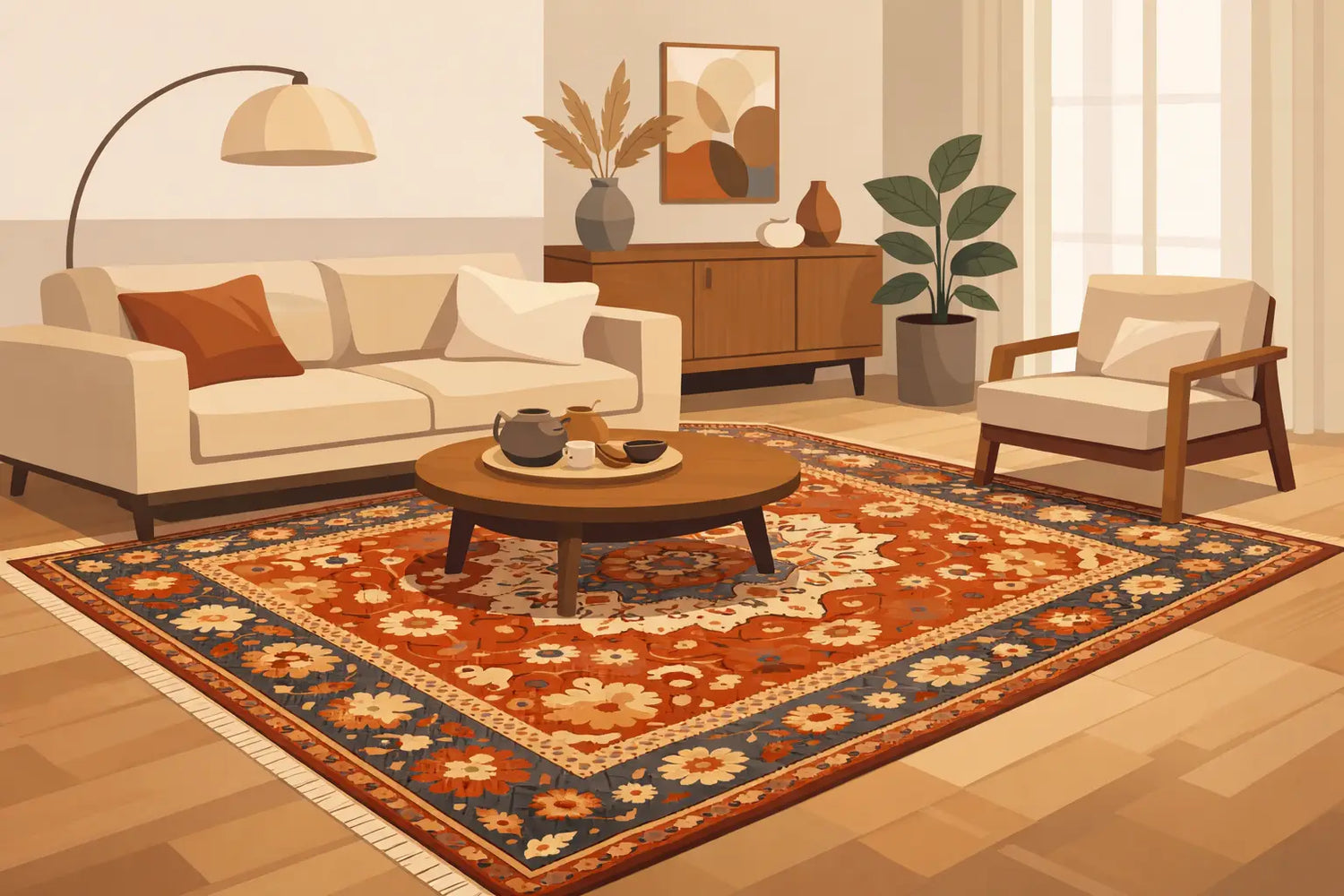
A living room only truly feels complete when the floor supports the whole. That’s exactly why an oriental rug can make a living room much stronger than people often expect. It brings warmth to a sleek interior, adds depth to a neutral color palette, and creates a cozy foundation where the sofa, coffee table, and lighting come together beautifully.
An oriental rug is not a one-dimensional style choice either. Some people immediately think of dark red, heavy classic designs, and very bold patterns. That can be the case, but it doesn’t have to be. Today, you can also find refined oriental designs in soft beige tones, muted blue, subtle terracotta, or elegant black-cream combinations. This means such a rug fits not only in a traditional living room but also surprisingly well in modern, Scandinavian, or country-style interiors.
Why an oriental rug works in the living room
The living room is the place where comfort and appearance must meet. A beautiful sofa alone is rarely enough. Without textiles on the floor, a space quickly looks harsh, especially with tile floors, parquet, or laminate. An oriental rug makes the room softer, warmer, and visually richer.
This effect is not only about color but also about rhythm and detail. The patterns of an oriental rug bring movement into the space without becoming cluttered. That’s where the strength lies. While a plain rug mainly provides calm, an oriental model adds character. It’s as if the living room immediately gains more personality.
For families, there’s also a practical advantage. A rug dampens sound, feels more pleasant underfoot, and makes a seating area feel homelier. Especially in a space where people live, read, play, and entertain, that’s not a small detail but a big difference.
Which style suits your oriental living room rug?
The right choice depends on the atmosphere you’re looking for. Those who love a timeless, elegant living room often choose classic motifs with rich details. Think of medallions, ornate borders, and warm colors like burgundy, dark blue, or ivory. This kind of rug immediately gives a luxurious look and pairs beautifully with wooden furniture, velvet cushions, and soft lighting.
Prefer something lighter and more contemporary? Then there are oriental rugs with a faded look or subtle vintage effect. They retain the charm of traditional patterns but feel visually fresher. In a modern living room with clean lines, this provides just enough contrast. The space remains sleek but never cold.
Even in a beige or greige interior, an oriental rug works particularly well. It breaks up monotony and adds nuance without shouting. A pattern in sand, taupe, or soft blue can be enough to make the living room feel more layered.
The right size makes everything more believable
A beautiful rug in the wrong size completely undermines the effect. This happens more often than you think. Too small often looks like it was placed there by chance rather than connecting the seating area.
In the living room, it usually works best when at least the front legs of the sofa and armchairs are on the rug. This creates one cohesive whole. In a spacious seating area, the rug can even run fully under the furniture, as long as the proportions fit the room.
A smaller size can work in compact living rooms, but placement is crucial. The rug must feel deliberately chosen, not like a makeshift solution. Always measure your seating area first, including the coffee table and walking space. An oriental rug truly comes into its own when it supports the space instead of feeling lost.
Choosing color without doubt
Many customers like the pattern but hesitate about the color. That’s understandable because a rug strongly influences how a living room feels. Still, that choice doesn’t have to be difficult if you start from what’s already in your home.
If you have a light sofa and calm walls, the rug can be more present. Warm red tones, navy blue, or a rich pattern then bring depth and coziness. If your interior already has more color or decoration, it’s better to choose a softer oriental design with refined contrast.
Dark rugs are more forgiving with heavy use but can make a space feel a bit smaller. Lighter rugs visually open up the room, though they sometimes require a bit more maintenance. It’s not a matter of right or wrong but a balance between appearance and daily comfort.
Material and maintenance in real life
A living room must be beautiful but also livable. Especially in families with children, pets, or heavy foot traffic, maintenance plays a big role. That’s why it’s smart to look not only at the design but also at pile height, texture, and ease of use.
A low-pile oriental rug is often a very practical choice. It looks neat, is easier to vacuum, and stays beautiful in high-traffic areas. Moreover, chairs and coffee tables slide more easily over it than on a high-pile rug. For those who want to combine comfort and maintenance, this is often the best middle ground.
There are also models that feel softer yet remain easy to maintain, for example with a sturdy finish or anti-slip backing. This is interesting in homes where ease of use is as important as style. After all, a rug shouldn’t just look good on delivery day but still bring joy months later.
Those who truly love authentic appeal often look for hand-knotted or richly finished rugs. They have a unique charm and a strong presence in the room. On the other hand, they often require a larger investment. For some living rooms, that’s exactly the right choice. For other families, a more accessible, easy-care model is simply smarter. It depends on how you live.
Combining oriental with modern? Absolutely
One of the biggest misconceptions in interior design is that oriental only fits with classic styles. Often, the opposite is true. In a modern living room with sleek furniture, an oriental rug brings softness, history, and character. That mix makes an interior more interesting.
Think of a light gray corner sofa, black metal accents, and an oriental rug with weathered details in beige and blue. Or a minimalist space where one rich pattern on the floor adds all the warmth that the rest deliberately leaves out. That tension makes a living room less predictable and much more inviting.
It also works excellently in country-style interiors. Wood, linen, rounded shapes, and an oriental rug naturally enhance each other. The result feels warm, cared for, and lived-in without becoming heavy.
What to watch for when choosing online?
Buying a rug online requires trust but also some preparation. Don’t just look at the photo of the entire rug; try to imagine how the pattern looks up close and how the colors react to daylight in your living room. A rug that looks warm beige online can appear a bit grayer in a cool room.
Also read carefully whether the rug is suitable for heavy use, easy to maintain, and stays firmly in place. For many customers, free shipping, a clear product description, and an accessible price are decisive. Rightly so, because you don’t buy a rug every week. You want to feel confident.
At Omid Carpets, we notice that customers decide quickly when beauty and practical ease come together. An oriental rug that looks stylish, feels soft, and is easy to maintain simply fits better into daily life than a beautiful but difficult product.
When is an oriental rug less suitable?
It’s important to be honest about that too. In a very small living room with a lot of visual clutter, a heavy pattern can sometimes be too dominant. In that case, it’s better to choose a calmer oriental design or a model with faded accents. This way, you keep the charm but keep the room airy.
If your interior already has many bold prints, an oriental rug requires more coordination. That doesn’t mean it can’t work, but it’s better to choose a more limited color palette. A rug should support the space, not compete with it.
And if you aim for a completely ultra-minimalist look, you might feel better with a more subdued rug. Yet even there, a subtle oriental motif can work surprisingly well, as long as it’s not too heavy or contrasting.
A well-chosen oriental rug does something few other interior pieces can. It makes a living room warmer without adding extra furniture, more stylish without looking forced, and cozier without sacrificing comfort. If you choose with an eye for size, color, and daily use, it won’t be just a detail on the floor but the piece that brings your entire living room together.

Leave a comment
This site is protected by hCaptcha and the hCaptcha Privacy Policy and Terms of Service apply.