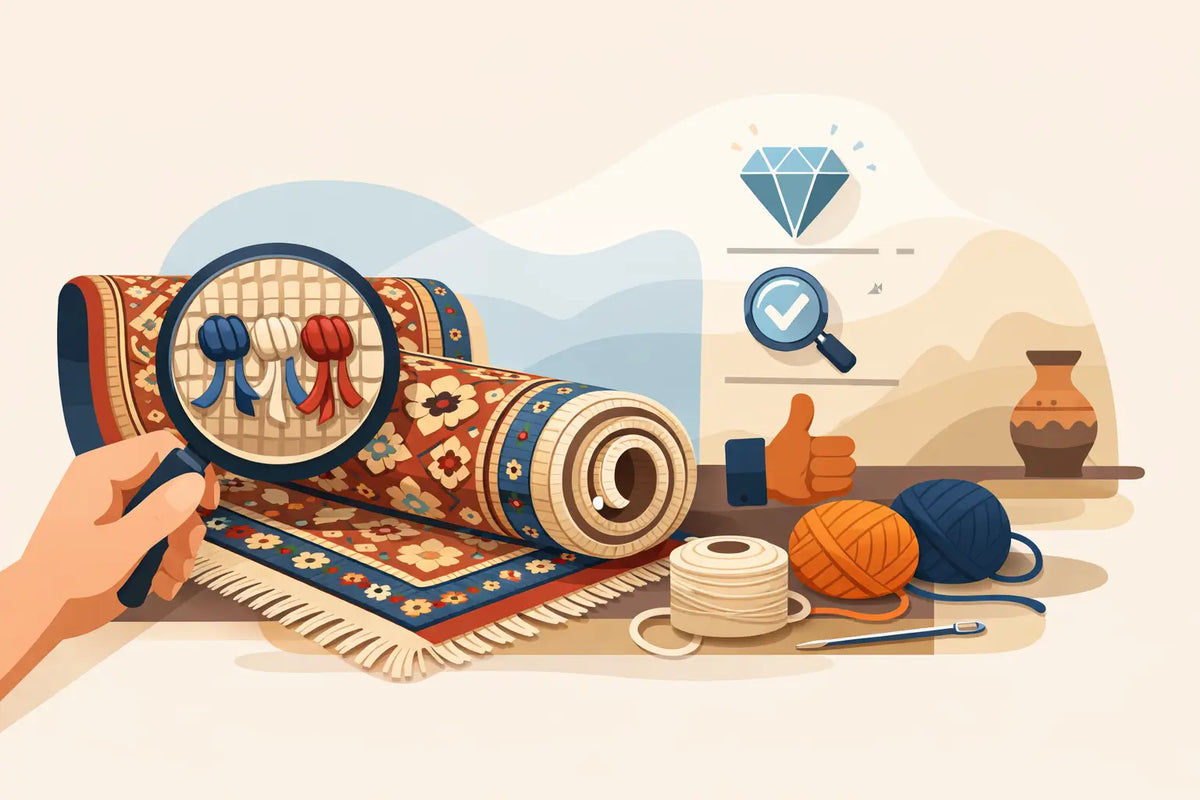
A hand-knotted carpet feels different as soon as you hold it. It has weight, character, and small irregularities that no machine can replicate. Therefore, anyone who wants to recognize a hand-knotted carpet by quality does not only look at the design or the price. The back, the knots, the material, and the finishing together tell the true story of a carpet that can bring warmth and beauty to your interior for years.
A good hand-knotted carpet is not an impulse purchase but a piece of craftsmanship for your home. It can add depth to a calm living room, make a bedroom softer, or create an elegant base under a dining table. With the right knowledge, you choose not only a beautiful carpet but also one that fits your family, your use, and your expectations.
Recognizing a hand-knotted carpet by quality: start with the back
The back is often the most honest place to look. Carefully turn the carpet over and study the pattern. On a genuine hand-knotted carpet, you will see the same design on the back as on the front, although less pronounced. You will see individual knots and fine, subtle variations in the lines. That is normal: human hands work with feeling, not with the perfect repetition of a machine.
On a machine-made carpet, the back is usually very regular, often finished with a latex layer, textile backing, or glue. The design may look printed rather than built up from knots. Fringes also provide a clue. On a hand-knotted carpet, the fringes are usually the extension of the warp threads of the carpet itself. On many machine-made models, they are sewn on afterward.
This does not mean that every machine-made carpet is less beautiful or less suitable. A washable low-pile rug with an anti-slip backing, for example, is particularly practical in a busy family. But those looking for craftsmanship, natural materials, and a carpet with its own character will mainly find those qualities in hand-knotted pieces.
Don’t just count knots, look at the entire weave
Knot density says a lot about the refinement of a hand-knotted carpet. The more knots per square meter, the more detailed the pattern can be and the more time has gone into the work. Fine floral motifs, small medallions, and sharp color changes naturally require a high knot density.
However, a higher number of knots is not automatically the best choice for every home. A very finely knotted silk carpet is beautiful in a quiet sitting area or bedroom but requires more care than a sturdy wool carpet in the living room. For a family with children, pets, or heavy traffic, a well-knotted woolen example is often the wiser investment. Wool is resilient, feels pleasantly warm, and hides daily use better.
Also, pay attention to the regularity of the knots. A quality carpet shows a dense and balanced surface without large open spots or loose ends. Small differences may be visible and are part of handmade work. Large differences in pile height, a crooked pattern, or noticeably thin areas can indicate less careful finishing or wear.
The pile should have life, not stick
Stroke your hand over the carpet in different directions. The pile of wool or silk subtly changes color depending on the light. This play of color, also called the nap effect, gives a hand-knotted carpet its lively appearance. The fibers should feel supple and mostly recover after light pressure.
A stiff, shiny, or plastic-like surface may indicate synthetic fibers or heavy chemical treatment. Synthetic materials are not necessarily bad, as they can be very low-maintenance and budget-friendly. However, for a carpet offered as hand-knotted and high-quality, you expect a material that feels natural, sturdy, and pleasant.
Material determines comfort, appearance, and use
Wool has been a beloved choice for hand-knotted carpets for generations. The fiber is naturally resilient, heat-insulating, and relatively dirt-repellent. A wool carpet feels rich underfoot and fits equally well in a classic interior as in a modern, calm living style. At first, wool may shed slightly, especially with a new carpet. This is usually normal and decreases with regular gentle vacuuming without a hard rotating brush.
Silk is often used for refined details or for fully silk carpets. The material gives a beautiful shine and makes patterns stand out sharply. On the other hand, silk is more sensitive to moisture, stains, and heavily trafficked areas. Therefore, choose it for a place where appearance is paramount and the carpet is not heavily used every day.
There are also carpets in which wool is combined with silk or other fibers. This mix can offer a nice balance between softness, shine, and durability. Always ask clearly which materials have been used. An honest description helps you correctly estimate price, maintenance, and lifespan.
Look at colors with attention to natural nuance
A hand-knotted carpet rarely has a flat, completely uniform color. Especially with wool, natural color differences can be visible. This adds depth and prevents the carpet from looking sterile. In traditional carpets, these nuances enhance the authentic character, while in contemporary designs they create a warm, layered appearance.
Preferably view the carpet both in daylight and under your own lighting. A deep red tone can look fuller under warm lamp light, while blue, gray, or beige show different undertones in bright daylight. Also consider the colors of your sofa, floor, and curtains. A carpet does not have to match exactly. In fact, a recurring accent color can bring the room together.
Those who want to keep a lighter living space often choose sand, cream, soft gray, or muted green. A darker or richly patterned hand-knotted carpet can be beautiful in a spacious living room where it can serve as a focal point. Under a dining table, a mixed pattern is also more forgiving for small stains and daily use.
Finishing shows how much care a carpet received
Examine the edges and ends carefully. The sides, also called selvages, must be finished firmly and evenly. They protect the carpet’s structure from fraying. The fringes should be neatly attached, without long loose threads or knots that seem ready to unravel.
Also check if the carpet lies flat. A slight waviness can disappear after the carpet has been on the floor for a while, especially after transport. Persistent bumps, hard creases, or a carpet that pulls strongly crooked deserve extra attention. A quality hand-knotted carpet lies stable and comfortable in place with a suitable underlay.
An anti-slip underlay is often a smart addition, especially on smooth floors like parquet, tiles, or laminate. It makes the carpet safer for children and helps limit wear caused by sliding. For underfloor heating, it is wise to check whether the chosen underlay and carpet are suitable for that.
Origin is valuable but not a quality stamp by itself
Afghan, Persian, Turkish, Indian, and Pakistani carpets can all be made with great craftsmanship. Each region has its own techniques, patterns, and materials. The origin provides context to the story of a carpet but is no guarantee without looking at the actual finishing.
Rather ask about the knotting technique used, the fibers, the age, and the condition of the carpet. In older or vintage pieces, small repairs can be part of their history. This is not a problem when done properly and honestly. A subtle restoration can even extend the lifespan, while large damages or weakened areas do affect usability.
Price also requires nuance. A large, finely knotted carpet made of high-quality wool or silk requires hundreds to thousands of hours of work and will not have the same price as a machine-made rug. At the same time, quality does not have to be unattainable. A simpler pattern, a smaller size, or a wool version can be a beautiful and accessible choice.
Choose quality that fits your life
The most beautiful purchase is not necessarily the finest or most expensive carpet, but the carpet you enjoy using. Measure your space carefully beforehand and determine where the front legs of your sofa, dining table, or bed will stand. A carpet that is too small often makes a room look restless, while a larger size provides cohesion and comfort.
Then think honestly about the use. In a quiet lounge, a refined piece can get all the attention. In a lively family home, it is better to choose resilient wool, a pattern that can tolerate some wear, and a size that remains practical. Regular vacuuming, quick response to spills, and occasional professional cleaning keep a hand-knotted carpet beautiful for a long time.
At Omid Carpets, we believe a carpet truly gains value when it becomes part of your home: under bare feet on a quiet morning, during a cozy evening with family, or as a warm base for a room that feels completely yours. So take the time to look, feel, and compare. A well-chosen hand-knotted carpet not only lies beautifully on the floor but grows with the memories you create around it.



Leave a comment
This site is protected by hCaptcha and the hCaptcha Privacy Policy and Terms of Service apply.