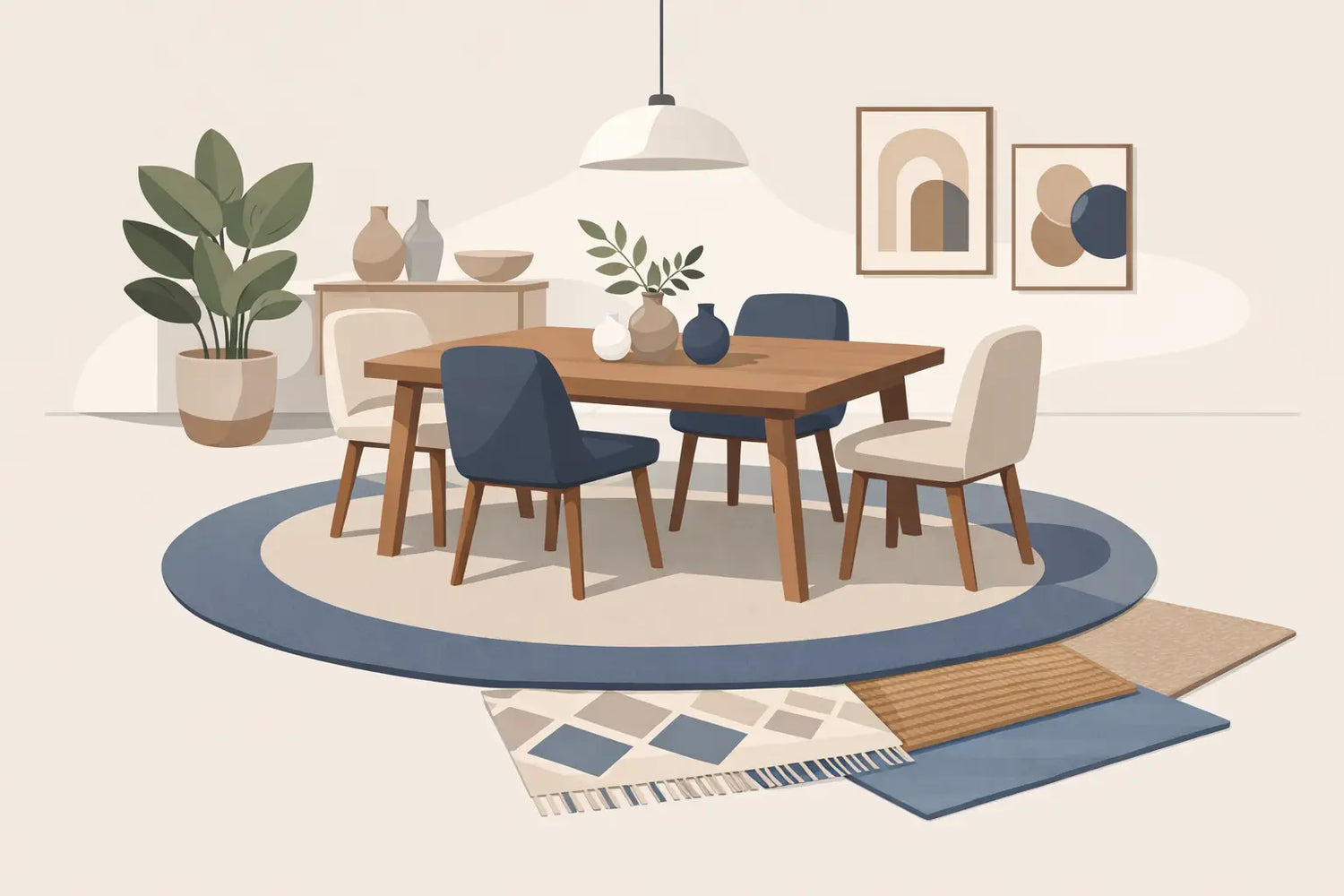
A dining table without a rug can look sleek and calm, but often something is missing: warmth, softness, and cohesion. If you wonder which rug works best under a dining table, you’ll quickly notice that appearance is only half the story. In a dining room, a rug should not only be beautiful but also practical with sliding chairs, crumbs, and the occasional spilled glass.
Which rug under the dining table is the right choice?
The right rug under the dining table brings the whole space together. It gives the dining area its own place in the home, dampens sound, and makes the room more inviting. Especially in homes with hard floors like tile, laminate, or parquet, a rug provides more comfort and a warmer atmosphere.
However, not every rug is suitable. A high-pile rug feels wonderfully soft, but under a dining table it quickly becomes impractical. Chairs slide less easily, crumbs sink deeper, and stains are harder to remove. That’s why most people choose a low-pile rug or a flatwoven model for this space. It looks neat, feels pleasant, and remains much more practical for daily use.
Always start with the right size
Size is usually the deciding factor. A rug that’s too small makes the dining room look messy and is frustrating to use. As soon as someone slides their chair back and ends up half off the rug, it feels unsettled and uncomfortable.
A good rule of thumb is simple: the rug should extend well beyond the table on all sides, so the chairs remain on it when pushed back. Ideally, allow at least 60 to 70 centimeters extra all around. If you have wide dining chairs or a large table, you can add a bit more.
For a rectangular table, you usually choose a rectangular rug as well. This creates calm and reinforces the room’s lines. Under a round table, a round rug often works beautifully because it creates a soft and harmonious whole. A square table can be paired with either a square or round rug, depending on your interior style.
Low-pile almost always wins
Those who want practical living without sacrificing atmosphere usually opt for low-pile rugs. That’s no coincidence. Under a dining table, there is daily movement, pressure, and dirt. You want a surface that stays neat and is easy to maintain.
A low-pile rug allows chairs to slide more easily and traps less dust and food debris. It often looks a bit tidier, fitting well in both modern and classic interiors. Especially for families with children, this is a smart choice. Accidents happen quickly, and it’s nice not to be stuck with a deeply set stain right away.
Flatwoven rugs are even more practical. They have little height texture, are sturdy, and easy to vacuum. Those who like a calm, neat look in the dining room usually find this a good option.
Which material works best under a dining table?
The material also deserves attention. In a dining room, you want to combine convenience with a beautiful look. Synthetic materials like polypropylene are therefore very popular. They are wear-resistant, colorfast, and usually easier to clean than delicate natural fibers. For a lived-in space, that’s a big advantage.
If you want extra comfort, there are also soft low-pile rugs that feel pleasant but remain practical. Some modern models are even washable, which is especially interesting in a dining room. That makes the difference between living cautiously and simply relaxing at the table.
Natural materials like wool have a rich appearance and feel luxurious. They can work perfectly under a dining table but require a bit more care. Wool is naturally strong and dirt-repellent, but not every household finds it convenient enough for intensive daily use. Here it really depends on your family, your living style, and how often you use the table.
Color and pattern: beautiful but also smart choices
In the showroom or online, the eye often first falls on color. Understandably, since a rug determines much of the atmosphere. Still, under a dining table, it’s better to choose not only with your eyes but also with your habits in mind.
A very light rug can be beautiful in an airy dining room but shows stains more quickly. A very dark rug often hides small stains better, but dust and crumbs can become more visible. Midtones are therefore often the safest and most beautiful choice. Think of sand, taupe, greige, warm gray, or soft earth tones. These create calm and combine easily with wood, black metal, beige chairs, or a natural table.
A subtle pattern is also smart. A mottled design or a refined motif camouflages small signs of use better than a completely solid-colored rug. This is especially useful in a dining room that is used intensively. Your interior stays neat even between cleanings.
Match the rug to your interior style
The best answer to which rug fits under a dining table also depends on the look you want. In a modern interior, a sleek low-pile rug in neutral tones often looks best. It creates calm and lets the table and chairs stand out beautifully.
In a warm, classic, or country-style interior, you can add more character. Think of a rug with a refined pattern, an oriental accent, or rich earth colors. This adds depth to the space and immediately makes the dining area cozier.
If you love a natural, soft living style, beige, sand-colored, and woven textures are often a beautiful choice. If you prefer a bit more punch, a deeper blue, terracotta, or olive green can provide just the right touch. The most important thing is that the rug supports the dining room without overpowering it.
Don’t forget the underside
A beautiful rug also needs to stay in place. Under a dining table, this is extra important because chairs move constantly. A rug that shifts is not only annoying but also less safe.
That’s why a non-slip backing or a good anti-slip solution is highly recommended. Especially on smooth floors like tiles or laminate, you’ll notice the difference immediately. The rug stays tidier in place, the room feels more cared for, and daily use is simply more comfortable.
Think practical without losing atmosphere
Sometimes there’s the idea that a practical dining room rug automatically looks simple or less stylish. Fortunately, that’s not the case at all. Today, many rugs combine easy maintenance with a soft appearance, refined finishing, and a warm touch in the home.
This makes it possible to choose smartly. You don’t have to choose between beautiful and practical. A solid low-pile rug in the right size, with a low-maintenance material and a thoughtful color, gives you both. For many families, that’s exactly what works: a dining room that looks beautiful but is also truly livable.
When is it better not to choose a rug?
To be honest: a rug under the dining table is not the best choice for everyone. If you have a very small space, chairs with very wide legs, or you eat daily with young children who often spill, a bare floor can sometimes be more practical. Also, in a very minimalist interior, some prefer to keep an open and airy effect.
Still, many people find that a well-chosen rug makes the space more pleasant. It softens hard lines, connects separate furniture pieces, and gives the dining room more character. Those who choose consciously usually get a lot of atmosphere and comfort from it.
What to consider when buying?
Don’t just look at the photo or color. Think about the whole situation: how big is your table, how many chairs are around it, how intensively do you use the space, and how much maintenance do you really want to do? These questions will guide you more quickly to the right choice than style alone.
For many Belgian families, a washable or low-maintenance low-pile rug is the best balance. It looks warm, feels pleasant, and fits a lived-in interior. At Omid Carpets, we see that customers mainly choose models that bring atmosphere without adding worries—and that is usually exactly the right direction under a dining table.
A dining room should be beautiful but above all invite you to sit at the table, stay longer, and live without stress. So choose a rug that not only fits your table but also your daily rhythm at home.


Leave a comment
This site is protected by hCaptcha and the hCaptcha Privacy Policy and Terms of Service apply.