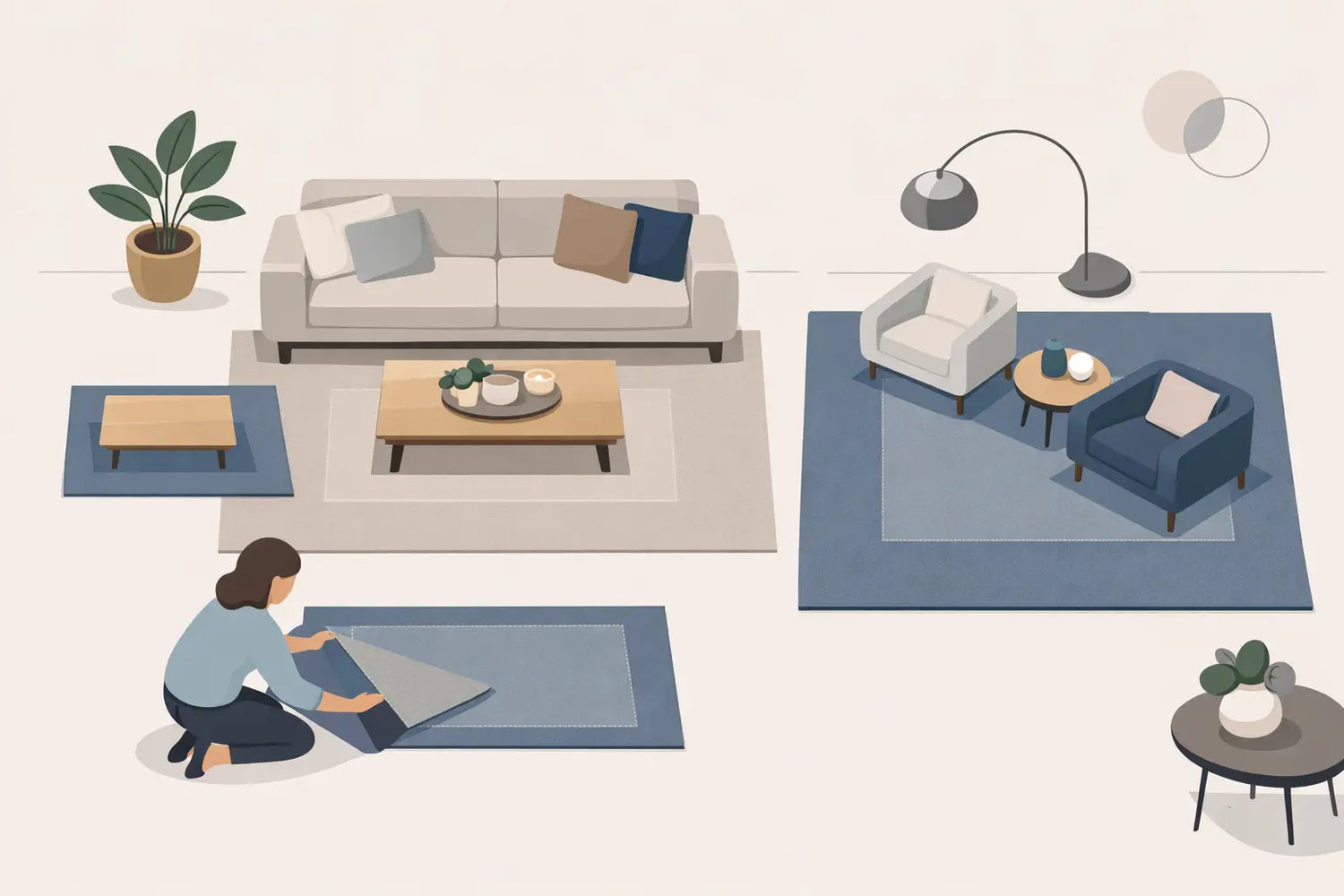
A living room can be beautifully decorated, but if the rug is too small, the entire space suddenly feels a bit lost. The question of how big a living room rug should be is therefore not a minor detail. It is often that one element that determines whether your living room looks warm, balanced, and finished.
Choosing the right size has less to do with taste alone and more with proportions. A well-chosen rug connects the sofa, coffee table, and armchairs into one cozy whole. If you choose too small, your furniture will seem disconnected. If you choose too large, the space can feel heavier than necessary.
How big should a living room rug be in practice?
The simplest rule of thumb is this: a living room rug should be large enough to visually bring your seating area together. In most living rooms, this means that at least the front legs of the sofa and any chairs are on the rug. This creates calm and a clear layout.
For a compact seating area, a rug of 160 x 230 cm often works well. In an average living room, 200 x 290 cm is a popular choice. If you have a large corner sofa or a lot of free space, you will more quickly end up with 240 x 340 cm or larger. The exact size naturally depends on your arrangement, but if in doubt, it’s usually better to choose something larger rather than too small.
That sounds simple, but there is nuance. Not every living room requires the same approach. The shape of your sofa, the type of seating, and even the distance to your TV cabinet all play a role.
The three most common arrangements
1. Only the coffee table on the rug
This is still often seen in smaller spaces, but it is rarely the most attractive solution. If only the coffee table is on the rug and all seating furniture floats around it, the whole often looks somewhat disconnected. It can work in a very small apartment or a narrow seating area, but it gives less luxury and less warmth.
Those who choose this arrangement must be extra careful that the rug is not too small. A mini-size rug under the table alone can quickly make a living room seem smaller.
2. The front legs of the furniture on the rug
This is the best balance between style and practical comfort for many homes in Belgium. The front legs of the sofa and armchairs rest on the rug, while the back remains off it. This creates a nicely defined seating area without immediately needing a very large size.
This arrangement works well in both modern and classic interiors. It feels spacious, neat, and inviting. Moreover, it remains more budget-friendly than an extra-large rug, which is a logical consideration for many families.
3. All furniture fully on the rug
In a spacious living room, this is often the most luxurious choice. The rug then truly becomes the foundation of your living room. Especially with large corner sofas, open living spaces, or homes with high ceilings, this creates a strong and elegant effect.
There is one condition: enough floor must remain visible around the rug. Usually, it’s best to keep a free border of about 20 to 40 cm on all sides, depending on the size of the space. Otherwise, it quickly looks like the rug takes up too much space.
How do you measure the right size?
Don’t start with the rug, but with your furniture arrangement. First measure the entire seating area: the width of the sofa, the distance to the coffee table, and the placement of any extra chairs. Then determine how many of those pieces you want to rest on the rug.
A handy trick is to tape the desired dimensions on the floor with painter’s tape. This way, you immediately see how big the rug will actually feel. On a photo or product page, a size often looks different than in your own living room.
Also consider walkways. In a passage or narrow living space, you want to avoid a rug that extends too far, so it doesn’t make the space impractical. Especially in a family with children, a beautiful living room is truly successful only if it remains comfortable for daily use.
How big should a living room rug be with a corner sofa?
With a corner sofa, size choice becomes extra important because a rug that is too small breaks the generous shape of the sofa. Usually, it’s best to choose a size where at least the front parts of both sides of the corner sofa are on the rug.
For a standard corner sofa, 200 x 290 cm is often a good starting point. If you have a larger setup or an open living room, 240 x 340 cm is usually stronger. Especially if you also have an armchair or side table in the same zone, you want enough surface area to connect everything nicely.
A small rug for a large corner sofa rarely benefits the space. The sofa then seems even bigger, while the rug almost disappears. This gives an unbalanced result, no matter how beautiful the pattern is.
The shape of your rug also makes a difference
Not only the size, but also the shape influences the overall look. A rectangular rug is the safest choice for most living rooms because it fits nicely with a classic seating arrangement with sofa and coffee table.
A round rug can surprisingly work well in a smaller seating area or in a space with many straight lines. It softens and adds playfulness to the interior. Still, a round model requires a bit more sense of proportion. If it’s too small, that becomes even more noticeable.
In a square seating area, for example with two sofas facing each other, a square rug can look very balanced. But here too: better generous than just barely enough.
Don’t forget the coffee table
A living room rug should not only fit under your sofa but also remain practical around the coffee table. Ideally, the rug extends well beyond the table so it doesn’t look lost in the middle. There should be enough soft surface left to make the seating area feel cozy.
Also pay attention to the proportion between table and rug. A large table on a small rug makes everything feel busy. A compact table on a generous rug usually looks calmer and more elegant.
Size is important, but material too
A perfect size really comes into its own when the rug also fits your lifestyle. In a busy family life, a low-maintenance model is often the smartest choice. Think of a low-pile rug that is easy to vacuum, or a washable model that better handles stains.
If you have children or a slippery floor, a non-slip backing is no luxury. Comfort is not only in softness but also in safety and ease of use. That often makes more difference in the long run than people expect beforehand.
Those seeking warmth and character might look at a classic rug or a richer woven model. Those who prefer a sleek interior tend to choose modern patterns and calm colors. Size remains the foundation, but the right finish makes the whole convincing.
Common mistake: choosing too cautiously
The most common mistake when asking how big a living room rug should be is that people measure too modestly. They fear that a larger rug will make the room smaller, while often the opposite happens. A spacious rug provides structure, lets furniture stand out better, and creates a more finished interior.
That doesn’t mean bigger is always better. In a small living room, a too dominant rug can also make the space feel heavy, especially with a dark pattern or thick pile. But in most cases, a living room rug can be chosen a bit more generously than your first instinct suggests.
If you’re unsure between two sizes, don’t just look at the price but especially at the effect in the room. A rug is not a minor purchase. It determines the atmosphere, comfort, and appearance of your seating area every day.
Which size fits your living room most often?
For a small living room or apartment, 160 x 230 cm is often a usable minimum, provided it still remains in proportion to your sofa. For an average Belgian living room, 200 x 290 cm is very often the right middle ground. If you have a large corner sofa, an open living space, or want a truly luxurious feel, you usually end up with 240 x 340 cm.
At Omid Carpets, we notice that customers who dare to choose a slightly larger size are most often satisfied with the result afterward. The seating area feels calmer, warmer, and much more like one whole. You don’t just see it, you also feel it when you enter the space.
A living room only becomes truly inviting when everything is right: the soft texture under your feet, the right size under your furniture, and an appearance that brings warmth effortlessly. So don’t just measure your floor, but especially look at how you want to live – spacious, cozy, and ready for every day.


Leave a comment
This site is protected by hCaptcha and the hCaptcha Privacy Policy and Terms of Service apply.